Heavy copper PCB for automotive applications is the best pick for car projects. It works well with high currents and tough conditions. Engineers know that the right heavy copper PCB helps keep cars safe and functioning optimally. More than 60% of car electronic problems stem from PCB troubles. These issues often arise due to poor board material or inadequate design.
| System Type | PCB Finish Type | Impact on Reliability and Safety |
|---|
| Sensor Systems | ENIG | This finish keeps signals strong and safe from the environment. |
| Communication Systems | ENIG | It helps data move fast and lowers mistakes in data. |
| Power Management | ENIG/HASL | It makes the board strong against heat and shaking, so solder joints do not break. |
When selecting a PCB, especially a heavy copper PCB for automotive use, you should consider current, heat, and cost. These factors will help you choose the best option.Heavy Copper PCB vs Standard PCB
What Is a Heavy Copper PCB
A heavy copper PCB has much thicker copper layers than a standard board. Engineers pick copper thicknesses starting at 3 ounces per square foot. They can go up to 14 ounces. This kind of copper PCB can handle high currents and strong heat. Heavy copper PCB design makes the board strong and reliable for hard jobs. These boards are used in electric vehicles, power converters, and motor controllers. Thick copper layers help spread heat and carry more electricity without damage. Heavy copper PCB design also helps the board survive shaking and temperature changes.
| Copper Thickness Range | Description |
|---|
| 3oz | Minimum thickness for heavy copper PCBs |
| 14oz | Maximum thickness for heavy copper PCBs |
Heavy copper PCB design supports car systems that need lots of power and safety. The thick copper helps the board last longer, even in tough places.
What Is a Standard Copper PCB
A standard copper PCB uses thinner copper layers. Most standard boards have a copper thickness of 1 ounce per square foot. That is about 35 micrometers. Some designs use 2 ounces for higher current needs. Standard copper PCB boards work well in simple circuits, sensors, and control units. They cost less and are easier to make than heavy copper PCB designs.
| Copper Thickness | Description | Application |
|---|
| 1 oz/ft² (35 μm) | Industry standard for most designs | General-purpose projects, sensors, and lighting |
| 2 oz/ft² (70 μm) | Used for higher current needs | Power electronics, automotive boards |
Standard copper PCB boards fit many car uses. But they cannot handle as much current or heat as heavy copper PCB designs.
Copper Thickness Explained
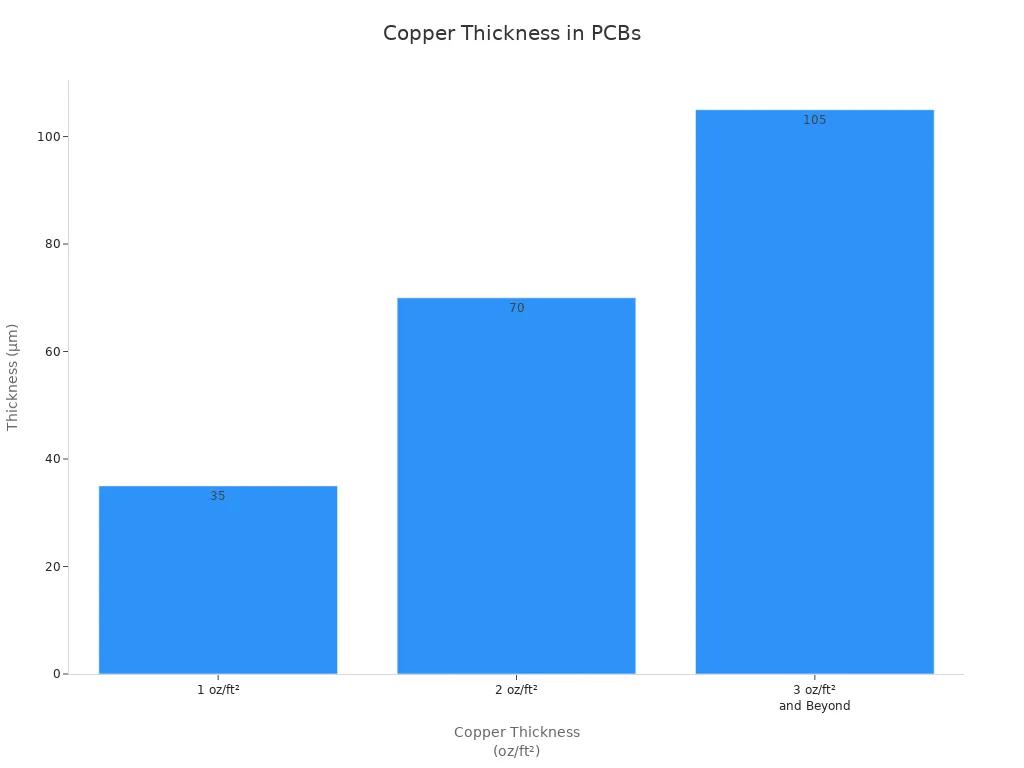
Copper thickness is important for how a copper PCB works. The thickness affects how much current the board can carry. It also affects how well it can spread heat. In heavy copper PCB design, engineers use thick copper to move more electricity and keep the board cool. Thicker copper lowers electrical resistance. This means less energy is lost as heat.
| Copper Thickness (oz/ft²) | Measurement (μm) | Application |
|---|
| 1 oz/ft² | 35 μm (1.4 mils) | Standard PCBs for consumer electronics, automotive, and industrial |
| 2 oz/ft² | 70 μm (2.8 mils) | Power supply boards, motor controllers |
| 3 oz/ft² and Beyond | >105 μm (>4 mils) | High-current applications like power amplifiers, welding devices |
Thicker copper layers in a heavy copper PCB act as heat sinks. They help remove heat from critical components and prevent overheating. This makes heavy copper PCB design important for electric cars and power systems. Standard copper PCB boards do not provide the same heat dissipation or current handling. Heavy copper PCB design gives better performance, safety, and durability for car electronics.
Typical Automotive Uses
Automotive engineers pick different PCBs for each car system. They look at how much current and heat each system makes. Heavy copper PCBs and standard copper PCBs are both important in cars.
Heavy copper PCBs are used in systems with high current and heat. These boards are found in electric and hybrid cars. They help control power and keep the car safe. Battery management systems use heavy copper PCBs. These systems control how electricity moves from the battery. They often handle up to 200 amps of current. The thick copper stops the board from getting too hot or breaking.
Power inverters also need heavy copper PCBs. These devices change DC power into AC power for the motor. This process makes a lot of heat and needs strong boards. Heavy copper PCBs spread out the heat and keep things working well. On-board chargers use heavy copper PCBs too. These chargers fill the battery fast and safely. Thick copper keeps voltage drops small and stops heat from building up.
Standard copper PCBs are good for systems with low current. They are used in sensor circuits, lighting controls, and communication modules. These boards cost less and are easier to make. Standard copper PCBs still work well for many car jobs. They help control lights, check engine parts, and send signals in the car.
The table below shows where heavy copper and standard copper PCBs are used in cars:
| Automotive Subsystem | Description |
|---|
| Battery Management Systems | Heavy copper PCBs handle currents up to 200 amps for safe and efficient power distribution. |
| Power Inverters | These PCBs manage high currents during the conversion of DC to AC power for electric motors. |
| On-Board Chargers | Heavy copper ensures minimal voltage drop and heat buildup during fast charging cycles. |
Note: Engineers use heavy copper PCBs for systems that move a lot of electricity or get very hot. Standard copper PCBs are best for low-power circuits and control units.
Why Heavy Copper PCB for Automotive
High Current Handling
Heavy copper PCB for automotive use is great for high current. Electric cars and strong motor systems need to move a lot of current. Thick copper layers help the PCB carry more current and stop it from getting too hot. For example, a 5-oz copper PCB can carry 10 to 12 amps in each square inch. This makes it good for battery systems and motor controllers. Some heavy copper PCB designs in cars can handle hundreds of amps. They help electric cars and big machines get the power they need.
| Copper Weight | Typical Applications | Current Handling |
|---|
| 5oz | EV battery systems, medium-power machines | 10-12 Amps per square inch |
| 10oz | Large solar inverters, industrial machines | High |
| 20oz | High-voltage systems, power distribution | Very high |
Heavy copper PCB for cars gives steady power and lowers the chance of circuit problems. This strong current ability helps the car work well in tough places.
Superior Heat Dissipation
Getting rid of heat is very important in car electronics. Heavy copper PCB for cars cools better than standard boards. Thick copper layers, like 3 oz/ft² or more, make the board hold and move heat well. This design cuts thermal resistance by about 15 percent. It helps control heat in strong circuits. Heavy copper PCBs use rolled foils and direct plating to make thick copper layers. These things help the PCB spread heat fast and stop hot spots.
Car engineers pick heavy copper PCBs for systems that need good heat control. Good heat control keeps parts safe and helps the board last longer. Better cooling means the system can take high currents without getting too hot. This is very important for power electronics in electric cars.
Mechanical Strength & Durability
Car electronics face shaking, big temperature changes, and stress. Heavy copper PCB for cars is strong and lasts a long time. Tests show these boards can go through over 1,000 hot and cold cycles from -40°C to 125°C without breaking apart. This lowers the chance of problems by 60 percent compared to standard copper PCB boards. Heavy copper PCB is also 30 to 40 percent better at handling shaking. This makes it good for strong and high-power systems.
| Test Type | Result |
|---|
| Thermal Cycle Endurance | Over 1,000 cycles, 60% fewer failures than standard boards |
| Vibration Resistance | 30-40% better fatigue resistance |
| Enhanced Mechanical Strength | Extra copper weight adds structural integrity |
The extra copper in heavy copper PCBs for cars makes it more reliable and stronger. These boards keep working even in hard car conditions. They help meet the power and current needs of new cars.
Lower Electrical Resistance
Heavy copper PCBs have a big advantage in cars. It lowers electrical resistance. Electrical resistance is how much a material slows down electricity. If resistance is high, more energy turns into heat. Less energy gets to the parts that need it. This can cause problems in cars. Parts may get too hot or lose power. Sensitive parts can even break.
Heavy copper PCB uses thick copper layers. Thick copper lets electricity move easily. It gives a wider path for the current. This helps the board carry more power. The board does not get hot as fast. For example, a standard PCB with 1 oz copper loses more energy as heat. It can lose up to 20% more than a heavy copper PCB with 5 oz copper. This matters in systems that use lots of power. Electric car batteries and power inverters need this.
| Copper Thickness | Electrical Resistance | Heat Generation | Power Efficiency |
|---|
| 1 oz/ft² | High | More | Lower |
| 3 oz/ft² | Medium | Less | Higher |
| 5 oz/ft² | Low | Least | Highest |
Lower resistance helps the board give a steady voltage. All parts get the power they need. Sensors, controllers, and motors work better. In electric cars, lower resistance helps the battery last longer. It also helps the car drive farther. Heavy copper PCB keeps voltage drops small. Even when the system uses lots of current, it works well.
Note: Lower resistance in heavy copper pcb stops hot spots and circuit failure. This makes the board safer and more reliable for cars.
Engineers pick heavy copper PCBs for parts that need strong power. These boards stop energy loss and overheating. They help make smaller systems. Thick copper can handle more current in less space.
Automotive Requirements for Copper PCBs
Electrical Performance
Automotive systems need copper PCB boards that work well. Engineers make these boards to handle high voltage and large currents. Electric cars often use voltages from 400 to 800 volts. Some systems need copper thickness from 2oz to 6oz. These boards can carry currents up to 600 amps. Wide traces and busbars help stop energy loss. Low-inductance layouts keep voltage spikes small. This protects sensitive parts from damage.
| Aspect | Requirement Details | Application / Notes |
|---|
| High-Voltage Handling | Voltage: 400V–800V
Current: up to 600A
Copper thickness: 2oz–6oz
Wide traces (≥5mm for 300A)
Low-inductance layouts | Traction inverters, EV power systems |
| Insulation & Safety | Creepage: ≥4mm (400V), ≥6mm (800V)
Clearance: ≥3mm (400V), ≥5mm (800V)
High-Tg FR4 ≥170°C
UV-resistant solder masks | Prevent arcing, short circuits, and ensure functional safety |
| Thermal Management | Thermal vias (0.3–0.5mm diameter)
Metal-core PCBs
High-Tg and low-CTE materials | Maintain reliability and efficiency under high heat loads |
Copper PCB boards must also have good insulation. The right space between traces stops short circuits. Strong materials like high-Tg FR4 or ceramic composites help the board survive heat. Good thermal management keeps the copper PCB cool and working well.
Environmental Resistance
Automotive copper PCB boards face harsh conditions. They must resist heat, water, and shaking. ISO 16750 sets rules for testing these boards. It checks how they work in changing temperatures and high humidity. The standard also tests for vibration and shock. These things happen often on the road.
●Engineers pick materials that do not soak up much water.
●They use copper PCB designs with high thermal conductivity.
●The boards must survive big temperature changes.
1.ISO 16750 gives steps for testing against temperature and humidity.
2.It also covers vibration and shock tests to make sure the copper PCB stays strong.
Note: Copper pcb boards that pass these tests last longer and keep car systems safe.
Safety & Compliance
Safety is very important in car electronics. Every copper PCB must meet strict standards. ISO 26262 covers safety for road vehicles. It has rules for hazard checks, risk checks, and safety needs. Engineers also follow AEC-Q100 for stress tests and failure checks.
| Standard | Description | Key Aspects |
|---|
| ISO 26262 | Functional safety for road vehicles | ASIL levels, hazard analysis, safety requirements, verification, documentation |
| AEC-Q100 | Stress test qualification for automotive ICs | Stress tests, failure analysis, temperature grading, ESD, and latch-up testing |
Copper PCB boards that meet these standards help stop failures and accidents. They also make sure the board works well in all driving conditions. Following these rules gives car makers and drivers peace of mind.
Cost and Manufacturing Factors
Material and Production Costs
Material and production costs are important when picking a copper PCB for cars. Standard copper PCB boards use less copper. This keeps their material costs low. Heavy copper PCB boards use more copper. This makes them cost more. Factories need special steps to make thick copper layers. These steps add extra cost.
| PCB Type | Material Costs | Manufacturing Complexity |
|---|
| Standard PCBs | Lower | Easier |
| Heavy Copper PCBs | Higher | More specialized |
Heavy copper PCB boards can cost half again as much as standard boards. For example, a 2oz copper PCB costs about 15–20% more than a 1oz board. If copper thickness goes above 3oz, the price gets even higher. More copper means longer etching and careful handling.
Manufacturing Complexity
Making heavy copper PCB boards is harder than making standard boards. Thick copper layers can cause mistakes during alignment. Factories throw away more boards when making heavy inner layers. Uneven copper thickness can bend the board during lamination. This lowers the number of good boards and affects quality.
●Thick copper layers can cause mistakes in alignment.
●Factories throw away more boards with heavy inner layers.
●Longer etching times can cause problems like an undercut.
●Extra plating and high current can cause dendritic growth.
●Careful control of copper thickness helps stop bending.
Heavy copper PCB boards need special care during production. Making them takes more time and skill. Standard copper PCB boards are easier to make and have fewer issues.
Lead Time and Batch Flexibility
Lead time is how long it takes to make a copper PCB. Heavy copper PCB boards usually take more time to produce. The normal lead time for heavy copper PCB boards is about 15 days. Some factories can make samples in just 3 days. Standard copper PCB boards often take less time because the process is easier.
Car projects sometimes need quick delivery. Batch flexibility helps with testing and making new boards. Heavy copper PCB boards may need more planning because they take longer and are harder to make.
Tip: Engineers should plan ahead when ordering heavy copper pcb boards. Longer lead times and higher costs can change project schedules.
Picking a heavy copper PCB or a standard copper PCB depends on what the project needs. Engineers must think about cost, how hard it is to make, and timing to get the best results.
Choosing the Right Copper PCB
Assessing Project Needs
Each car project has its own needs. Engineers must check many things before picking a copper PCB. They should think about these points:
●How many layers does the board need? Some projects use 4 to 6 layers. This keeps signals clear and separates strong current paths from sensitive spots.
●If the supplier can make thick copper layers. Etching copper thicker than 6oz is important for safety systems like emergency brakes.
●If the board fits with the assembly tools. Boards thicker than 3.0mm may need special tools. This stops bending during soldering, especially for small parts.
●If the board meets strict safety rules. Boards must survive 1,000 heating and cooling cycles from -40°C to 125°C. This is very important for steering systems.
Tip: Engineers should list all project needs before picking a board. This helps stop problems later.
Matching PCB Type to Application
Different car systems need different copper PCB types. Heavy copper boards are best where power and strength matter most. Standard boards are better for low-power or simple circuits.
●Heavy copper boards are used in powertrains and battery management systems. These parts face shaking, heat changes, and stress from the road.
●Electric cars need heavy copper boards for strong current and long life.
●Standard boards work well for sensors, lights, and control units. These do not need to handle much power.
A table helps match the right board to each job:
| Application Area | Best PCB Type | Reason |
|---|
| Powertrain/Battery | Heavy Copper | Handles high current and tough conditions |
| Sensors/Lighting | Standard | Lower cost and enough for simple circuits |
| Communication Modules | Standard | Good for low-power signal processing |
Consulting with Manufacturers
Talking to skilled manufacturers helps engineers make good choices. They advise about design, materials, and safety. Good manufacturers offer:
●High quality and strong testing for every board.
●Fast delivery and short wait times.
●Clear communication and teamwork during the project.
●Boards that meet all safety and environmental rules.
●Support for local jobs and skills.
Note: Early talks with manufacturers can save time and money. They help find problems before production starts.
Picking the right copper PCB means checking the project’s needs, matching the board to the job, and working with trusted partners. This leads to safer and more reliable car electronics.
Manufacturer Selection Guide
Technical Capabilities
Picking a PCB manufacturer for cars means checking their skills. They must have experience with high-current car systems. Their electroplating process needs to be steady and accurate for thick copper layers. Good thermal management stops boards from bending. Clear talks about design and making limits are important too.
●Experience with high-current car systems
●Steady and accurate electroplating for thick copper layers
●Good thermal management to stop board bending
●Clear talks about design and making limits
Manufacturers should know how materials change with heat. They often give thermal simulation data to help engineers guess how boards will work. Many top manufacturers make current paths better and use advanced plating for stronger boards. Heavy copper PCB manufacturers with these skills can help with hard car designs.
Fast Delivery & Support
Car projects often need to be finished quickly. Manufacturers with lots of experience can make PCBs fast and help customers at every step. For example, Shenzhen Benlida Circuit has more than 35 years in the car business. They use quick prototyping and flexible production to meet deadlines.
| Evidence Point | Description |
|---|
| Industry Expertise | More than 35 years of making PCBs for cars. |
| Rigorous Quality Control | Follows IATF 16949 and IPC Class 3 rules for strong boards. |
| Fast Turnaround | Quick prototyping and flexible production times. |
Strong support teams help engineers fix problems fast. They answer questions about design, materials, and testing. Good support means fewer delays and better results.
Tip: Pick a manufacturer with a good history in car projects. Fast delivery and strong support help keep your project on time.
Certifications & Quality
Certifications show a manufacturer follows rules for quality and safety. IATF 16949 is the main quality system for car suppliers. This standard uses tools like APQP and FMEA to keep products strong and safe.
Manufacturers should also have other important certifications:
| Certification | Description |
|---|
| IATF 16949 | International quality system for car suppliers. |
| ISO 9001 | Makes sure products meet customer needs. |
| UL | Meets safety rules for electrical uses. |
| IPC | Follows the best ways for PCB design, assembly, and checking. |
| RoHS | Follows rules about dangerous substances. |
Many car companies need IATF 16949. ISO 26262 is also important for safety in electronics. These certifications help make sure PCBs are safe and reliable in cars.
Note: Always check for current certifications before picking a manufacturer. This step keeps your project safe and helps boards last longer.
Picking between heavy copper and standard PCBs depends on a few main things. If your project needs to handle lots of current or heat, you need thicker copper. Small spaces in cars can use thicker copper to fit more power. Strong boards are better because they do not break from shaking or stress. You also have to think about how much the board costs and if it is easy to make. The board must follow safety rules like ISO 26262 to be safe and reliable.
| Material Type | Performance | Cost Level |
|---|
| Standard FR-4 | Good for simple circuits | Low |
| High-Tg FR-4 | Better heat resistance | Moderate |
| Polyimide | Top durability | High |
Car electronics need careful choices. Engineers should talk to skilled PCB makers to get the best boards. Good choices help keep cars safe and working well.
FAQ
What is the main difference between heavy copper and standard PCBs?
Heavy copper PCBs have thicker copper layers. Standard PCBs have thinner copper layers. Heavy copper boards can handle more current and heat. Standard boards are good for simple circuits.
Why do automotive projects need heavy copper PCBs?
Heavy copper PCBs carry high current and spread heat well. They last longer in tough places. Engineers use them in electric cars and power systems.
Can standard PCBs work in automotive electronics?
Standard PCBs are used for low-power jobs. They control sensors, lights, and signals. They cost less and are easier to make. They cannot handle high current or heat.
How does copper thickness affect PCB performance?
Thicker copper lowers resistance and spreads heat better. It helps the board carry more power. Thin copper works for simple circuits, but cannot handle strong currents.
Are heavy copper PCBs more expensive?
Heavy copper PCBs cost more money. They use extra copper and need special steps to make it. Standard PCBs cost less and take less time to produce.
What certifications should automotive PCBs have?
Automotive PCBs need IATF 16949, ISO 9001, and UL certifications. These show the board meets safety and quality rules. Engineers check these before picking a supplier.
How do engineers choose the right PCB for a car project?
Engineers look at current, heat, and safety needs. They match the PCB type to the job. They talk to manufacturers for advice and check certifications.
Can heavy copper PCBs improve car safety?
Heavy copper PCBs help stop overheating and circuit failure. They keep power steady and protect sensitive parts. This makes electric cars and power systems safer.
About the auther:

Sonic Yang
As a major of Electronics and Mechanical Automation, Sonic has been engaged in PCB design, R&D, manufacturing of eletronics for around 22 years, as engineering director and coordinates with supply chain(components&CNC parts), providing professional supports and consults for global customers.

 en
en


 WhatsApp