Output of voltage turning lower is a very common phenomenon, the root causes lie in an abnormality in one or more components of the power supply's "closed-loop control system," preventing the power supply system to output the correct voltage.
The power supply is a regulation system of voltage: it monitors the output voltage in real time, compares it to the set value, and immediately adjusts internal switches to increase the output, if it detects a low voltage. If monitoring and feedback loop isn't accurate, regulation malfunctions, or external resistance too high, the output will be turning low.
Diagnostic Framework: Troubleshooting from symptoms to root causes, starting with the simplest, such as external factors and then go for internal factors:
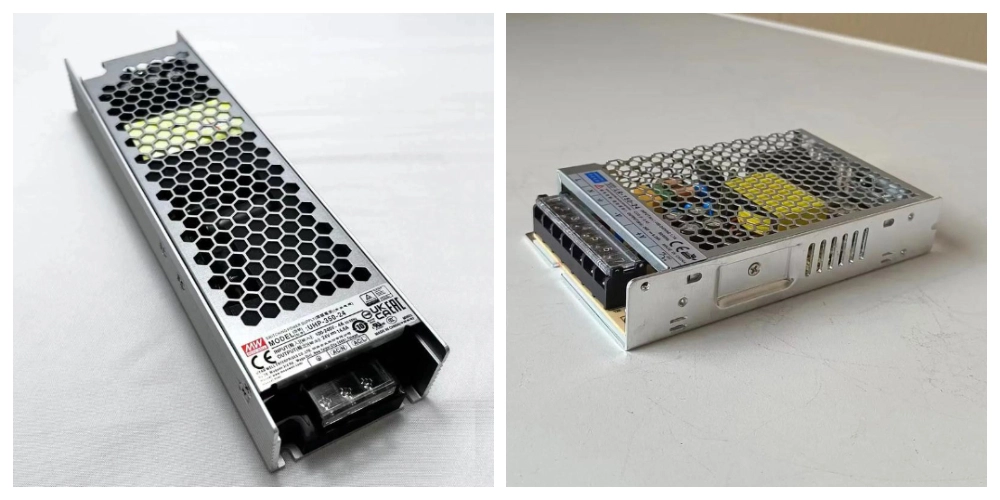
I. External Factors (First and easlist)
1. Low Input Voltage or Insufficient Power:
● Symptoms: Insufficient voltage from the front-end adapter, battery, or power grid, causing the power board to fail the operation within it's rated input range.
● Troubleshooting: Directly measure the voltage at the power board's input terminals, to check is it drops below the minimum operating voltage under load.
2. Overload or Short Circuit:
● Symptoms: A partial short circuit in the load or power consumption exceeding the power supply's rated power, triggers the power supply's protection, causing it to enter current limiting mode, resulting in a lower output voltage.
● Troubleshooting: Disconnect the load and measure the power supply board's output voltage under no-load conditions. If the no-load voltage returns to normal, the problem lies on the load side. Use a multimeter to measure the load's input impedance to determine if there is a short circuit.
II. Internal Factors (Power Supply's Inner Failures)
A. Feedback Loop Abnormalities (Most Common and Detailed)
This is the power supply's "brain and eyes," responsible for monitoring and adjustment.
● The value of voltage sensor resistor for output (voltage divider resistor) changed: Usually, the pull-up or pull-down resistor connected to the output terminal, increases in value, causing the feedback voltage (FB) to be high. The control chip mistakenly judges the output is sufficient, thus reducing the duty cycle and lowering the actual output.
● Unstable source of reference voltage (e.g., TL431): A drifting reference leads to an incorrect feedback reference.
● Optocoupler (in isolated power supplies) performance degradation: The optocoupler's current transfer ratio decreases, leading to attenuation of feedback signal, and controller chip react wrongly.
B. Power conversion and filtering section
This is the "heart and blood vessels" of the power supply, responsible for energy transfer and purification.
● Output filter capacitor's failure: This is a failure in high probability. Drying out (reduced capacitance) or aging (increased equivalent series resistance ESR) of the capacitors will result in poor filtering performance and a sharp decrease in load capacity. The voltage drops immediately once a load is applied.
● Performance degradation of power switching transistor (MOSFET) or rectifier diode (Schottky/fast recovery diode): Increased on-resistance, increased forward voltage drop, decreased conversion efficiency, increased losses, leading to insufficient output.
● High-frequency transformer problems: Minor short circuits between windings or increased core losses lead to reduced energy transfer efficiency.
C. Control and drive section
This is the "nervous system" of the power supply, responsible for issuing commands.
● Power supply for PWM control chip(Vcc) isn't correct: Unstable auxiliary power supply voltage to the chip, which lead to malfunction.
● Damage to the chip itself or external timing components: such as abnormal oscillator frequency.
● Insufficient drive capability: unable to drive the power switch transistor effectively and in full conduction.
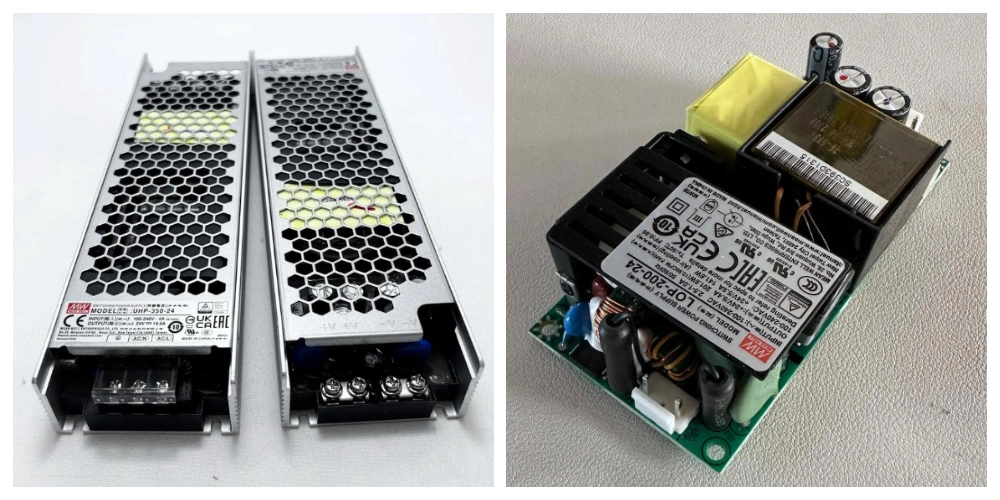
III. Failure Analysis
After check for components, such as in bad shape, status and conditition, if still cannot solve the issue, the professional analysis for failure should be consider and may pinpoint the root causes quickly:
1. Precise Testing for Electrical Performance:
● Dynamic Testing: Using electronic loads and oscilloscopes, test the power supply's load regulation and transient response to determine loop stability.
● Test the Components Parameter: Measure the parameters of key resistors, capacitors, and diodes online or offline, to check drift.
● Thermal Scanning: Quickly locate overheated components (such as failed capacitors or degraded MOSFETs), which are normally the source of the faults.
2. Physical and Material Analysis:
● X-Ray Inspection: inspect internal solder joints, solder cavity voids, and winding structure, without damages.
● SEM/EDS Analysis: Slice the failed capacitor and observe electrolyte drying and electrode corrosion, using a scanning electron microscope; Analyze the IMC layer composition of the solder joints, to determine if it is cold soldered joint.
● Curve Tracing: Perform a complete I-V characteristic test on suspected semiconductor devices (MOSFETs, diodes), accurately check if their performance has degraded.
Summary:
When troubleshooting the output voltage turning lower, follow the principle of "from external to internal, from easy to difficult." First, confirm that the input and load are correct. Then proceed to check the output filter capacitors and feedback-sense resistors, they are two domains in high-risk. Finally, thoroughly check the power devices and control chips.
Benlida has been manufacturing PCB over a decade, then expanded PCB assembly services, nowdays our engineering team also provides support to customers, this article is generated by based on customer needs and our engineering performance.
About the auther:

Sonic Yang
As a major of Electronics and Mechanical Automation, Sonic has been engaged in PCB design, R&D, manufacturing of eletronics for around 22 years, as engineering director and coordinates with supply chain(components&CNC parts), providing professional supports and consults for global customers.

 en
en



 WhatsApp