Home > Blog > Industry News > Selecting the Right PCB Laminate: FR4 vs. High-Frequency Alternatives for Your Design
Selecting the Right PCB Laminate: FR4 vs. High-Frequency Alternatives for Your Design
Share
Dec 23
Source:
You want your device to work well and last long. The PCB laminate you pick is very important. It affects how electricity moves and how clear signals are. It also helps your device stay strong over time. High-frequency signals can change the laminate’s features. This can change how your device works. Some laminates deal with these changes better. Choosing the right PCB laminate stops delays. It keeps signals clear and helps your product last longer.
Key Takeaways
Pick FR4 if you want to save money. It is good for basic electronics. FR4 works best at lower frequencies.
Use high-frequency laminates like PTFE or Rogers for special designs. These keep signals strong at high frequencies.
Learn about dielectric constant and dissipation factor. Lower numbers mean better results and less signal loss.
Do not make common mistakes when picking laminates. Always check if materials work together. Run signal tests to make sure everything works well.
Buy from certified suppliers. They give you good quality and reliable products. This helps your PCBs last longer and work better.
FR4 vs. High-Frequency Laminates
Key Differences
You have many options when picking a PCB laminate. FR4 and high-frequency laminates are not the same. The table below shows how they are different:
Property
FR4
High-Frequency Laminates
Electrical Performance
Adequate at lower frequencies
Superior at elevated frequencies
Dielectric Constant Stability
Varies at high frequencies
Maintains stability
Loss Tangent
Higher at high frequencies
Lower, reducing signal loss
Cost
Cost-effective
Generally more expensive
Suitability for Applications
General-purpose
High-speed and RF applications
FR4 is good for most electronics that do not need high speed. You can use it for things that work at lower frequencies. High-frequency laminates, like PTFE or Rogers, are better for advanced designs. These materials keep their electrical properties steady, even when signals move fast.
Performance Overview
You want your signals to stay strong and clear. FR4’s dielectric constant changes when the frequency is high. This can make signals weaker and hurt performance. PTFE-based laminates keep the dielectric constant steady. They also have a lower loss tangent, so there is less signal loss.
FR4 works well for frequencies up to about 7 GHz. If your design uses higher signals, you should pick high-frequency laminates.
PTFE and similar materials are best for signals in the hundreds of MHz or GHz. They help keep signals clear and save energy.
Tip: If your project uses high-speed data or radio frequency signals, picking the right PCB laminate is very important. High-frequency laminates help stop problems like signal loss and unstable impedance.
You need to choose the material that fits your design. FR4 is a cheaper choice for many projects. High-frequency laminates give you better performance for advanced electronics. Picking the right PCB laminate helps your device work well and last longer.
Understanding FR4 Laminate
What Is FR4?
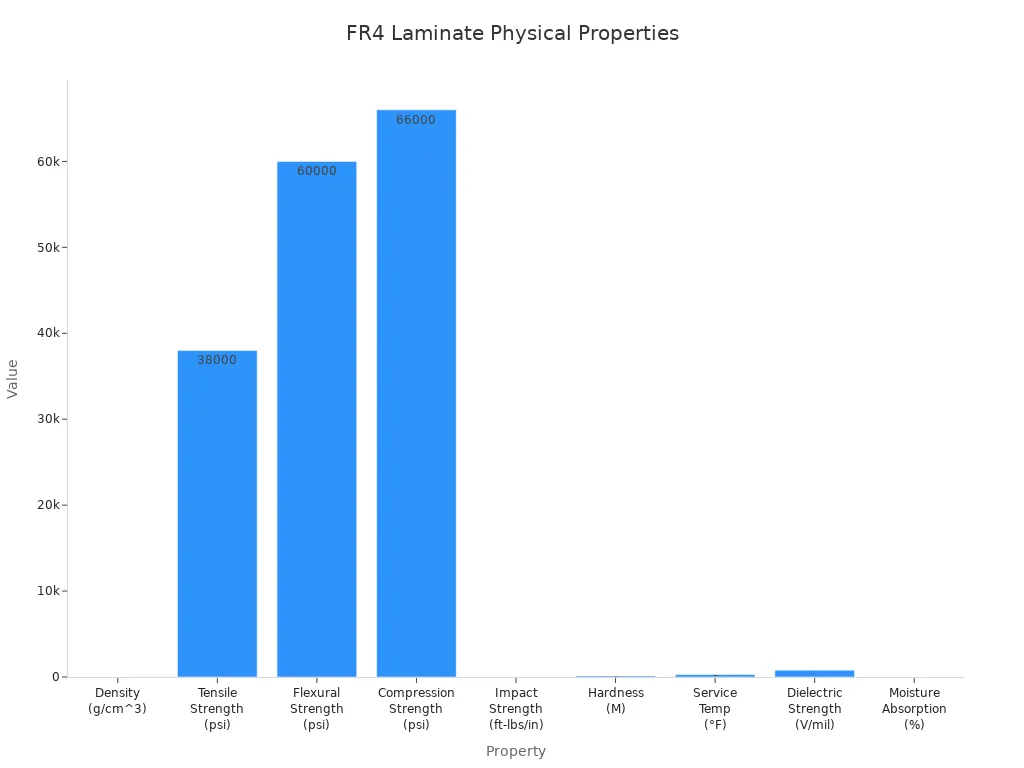
You can find FR4 in lots of electronics. FR4 is a glass epoxy laminate. It is made from glass fabric and epoxy resin. This makes it strong and dependable. FR4 does not catch fire easily. It also does not soak up much water. FR4 stays strong when it is wet or dry.
Here is a table that lists the main chemical and physical properties of FR4:
Property
Value
Chemical Designation
Glass Epoxy
Density (g/cm^3)
1.85
Tensile Strength at Yield (psi)
38000
Flexural Strength (psi)
60000
Compression Strength (psi)
66000
Impact Strength (Izod) (ft-lbs/in)
14
Hardness (M)
115
Service Temperature Continuous (°F)
284
Dielectric Strength (V/mil)
800
Moisture Absorption (%)
0.1
Flammability
V-0
FR4 is tough and safe for many jobs. It has a good strength-to-weight ratio. FR4 also works well as an electrical insulator.
Note: FR4 is used a lot for PCB designs. It is cheap and easy to make.
When to Use FR4
Pick FR4 if you want something strong and not too expensive. FR4 is also good at stopping electricity from leaking. FR4 is used in many areas:
Cars use FR4 in ADAS and power units because it is reliable.
Factories use FR4 in robots and sensors.
Computers and home gadgets often have FR4 inside.
Phones and lights also use FR4 because of its good features.
FR4 gives you many benefits:
It costs less when you make a lot of boards.
It is simple to use in normal PCB making.
It keeps electricity safe with high dielectric strength.
But FR4 has some limits. It does not work well with high-frequency or very hot designs. FR4 can break if it gets too much stress. For most electronics, FR4 is a good choice. You can count on it to work well and save money.
High-Frequency Laminate Options
PTFE and Rogers Materials
Sometimes, you need special materials for your PCB. PTFE and Rogers laminates are great for high-frequency jobs. PTFE is also called Teflon. It lets signals move with little loss. Rogers materials, like the 4350B series, work well up to 40 GHz. These laminates keep signals clear and strong, even when they move fast.
Here is a table that compares PTFE and Rogers laminates:
Property
Rogers 4350B
PTFE Teflon PCB
Dielectric Constant (Dk)
3.48 ± 0.05 at 10 GHz
Excellent dielectric properties
Loss Tangent
0.0037 at 10 GHz
Low signal loss
Thermal Stability
High Tg > 280 °C
Good temperature resistance
Moisture Absorption
0.06%
Very low moisture absorption
Thermal Conductivity
0.69 W/mK
Strong heat dissipation
These materials give you many good things:
Rogers 4350B keeps signals steady at high frequencies.
PTFE Teflon PCB does not break down in sunlight or air.
Both have low dielectric loss, so signals stay strong.
Tip: PTFE has a low dielectric constant, about 2.1. This is great for 5G and other fast signals. Rogers materials cost less and work well, with dielectric constants from 3.38 to 3.48.
When to Choose High-Frequency Laminates
Pick high-frequency laminates if you need fast, steady signals. These materials are best for RF and microwave circuits. They help stop signal loss and keep signals clear. PTFE and Rogers laminates help you get great signal quality.
Here is a table that shows where high-frequency laminates are best:
Type of PCB
Suitable Applications
Performance Characteristics
FR4
General electronics
Cost-effective, easy to manufacture
High-frequency laminates
RF and microwave circuits
Lower loss factors, better performance at elevated frequencies
These laminates can cost more and need special ways to make them. Rogers materials can cost $5 to $20 for each square foot. PTFE can cost more than $30 for each square foot. This is because it is rare and hard to make. You need special steps, but you get better results for tough jobs.
Pick high-frequency laminates for wireless, radar, satellite, or fast data PCBs. These materials help you choose the best PCB laminate when signal quality is very important.
Cost & Performance Factors
Dielectric Constant & Dissipation Factor
It is important to know how materials change your PCB’s performance. The dielectric constant (Dk) shows how much electrical energy a material can hold. This number affects how fast signals move and how much they slow down. The dissipation factor (Df) tells you how much energy becomes heat. Lower numbers mean less signal loss and better results.
Here is a table that compares some PCB materials:
Material
Dielectric Constant (Dk)
Dissipation Factor (Df)
FR4
3.8 to 4.9
0.004 to 0.020
PTFE
2.5 to 10.2
0.0014 to 0.0038
Polyimide
2.8 to 4.1
0.003 to 0.01
The dielectric constant changes signal speed and impedance.
The dissipation factor shows how much signal turns into heat.
Low Dk and Df numbers are best for fast designs.
If you want strong signals and less heat, pick materials with low Dk and Df. High-frequency laminates like PTFE help keep signals clear, even when they move fast.
Application Scenarios
You need to match your material to your project’s needs. FR4 works well for many electronics, but it is not good for high frequencies. When signals go above 1 GHz, FR4 can cause signal loss and crosstalk. High-frequency laminates fix these problems.
Here are some common uses:
Communication equipment: Home routers, switches, and base station control boards.
Automotive electronics: Body control modules, infotainment systems, and window or door lock units.
Application Scenario
Characteristics
5G Base Station AAU Modules
PTFE or ceramic-filled FR4 gives steady signals for advanced antennas
Optical Fiber Switching Equipment
Ultra-low Df FR4 helps fast data move with fewer mistakes
High-frequency laminates also work better in tough places. They keep their features steady when it is hot or wet. This makes them a smart pick for outdoor or factory use. You should always check your design needs to choose the right PCB laminate for your project.
Choosing the Right PCB Laminate
Design Requirements Checklist
You must pick a PCB laminate that fits your project. Every design needs different things. Look at how strong, safe, and heat-proof the material is. Also check how well it handles electricity. The table below shows what to check:
Category
Key Properties
Mechanical
Peel Strength, Flexural Strength, Delamination Time
Dielectric Properties, Insulating Properties, Electric Strength
Thermal
Glass Transition Temperature (Tg), Thermal Expansion, Thermal Conductivity, Decomposition Temperature
You want your PCB to last and work well. Strong boards do not break easily. Chemical resistance keeps water and chemicals out. Good electrical properties keep signals clear. Thermal properties help the board stay safe when it gets hot.
Think about what your board will do. High-frequency PCBs need special materials. These boards use PTFE or other advanced laminates to stop signal loss. Most regular PCBs use FR4 for normal jobs. The table below shows how needs change:
Aspect
High-Frequency PCBs
Standard PCBs
Materials
PTFE, FR-4, RF-35 (lower dielectric loss)
FR-4
Signal Integrity
Stringent requirements, impedance matching
Basic connectivity
Design Complexity
High complexity, requires controlled impedance
Relatively simple
Applications
RF circuits, radars, satellites, 5G
General electronics
Controlled impedance keeps signals from bouncing back.
Low-loss materials like Rogers RO4000 keep signals strong.
Shielding blocks unwanted signals.
Placing parts carefully helps control extra effects.
Tip: Write down what your design needs before you pick a laminate. This makes it easier to choose the right PCB laminate.
Common Mistakes
You want to avoid mistakes when picking a PCB laminate. Many people make errors that hurt how the board works or cost more money. You can learn from these common mistakes:
Error Type
Description
Solution
Material Combination
Laminating PTFE with FR-4 without checking CTE difference
Request specific combinations during design
Simulation Verification
Skipping signal transmission simulation
Always run simulations for verification
Universal Lamination
Using pure FR-4 profiles causing resin bleed-out
Use correct profiles for RF layers
Missing Transition Layer
Direct RF and FR-4 contact causing signal reflection
Add a transition layer to smooth Dk changes
Incorrect Drilling
High drilling speed roughens PTFE hole walls
Adjust speed for PTFE layers
Wrong Copper Foil Type
Standard copper increases high-frequency loss
Use rolled copper for RF layers
Insufficient Precision
Slot position errors cause poor bonding
Ensure precision in hybrid lamination
Lack of Reliability Test
Skipping thermal stress tests leads to cracking
Test reliability before batch production
Always use low-loss laminates for high-frequency boards. Rogers RO3003 and Isola I-Speed work well above 5 GHz. Rogers RO3003 has a dielectric constant of 3.0 and a loss tangent of 0.0010 at 10 GHz. Isola I-Speed has a dielectric constant of 3.6 and a loss tangent of 0.006 at 10 GHz.
Never mix PTFE with FR-4 without checking heat expansion.
Always test your design to find signal problems.
Use the right settings for lamination and drilling.
Pick rolled copper for RF layers to lower signal loss.
Test your board for strength before making many boards.
⚠️ Note: Skipping these steps can cause signal loss, weak bonds, or board failure. Careful planning helps you avoid these problems.
You can pick the right PCB laminate by using a checklist and learning from mistakes. This helps your board work better and last longer.
Supplier & Sourcing Tips
Evaluating Suppliers
You want a supplier who can make both FR4 and high-frequency PCBs. The boards should always be good quality. First, check what skills the supplier has and what materials they use. Good suppliers use special materials and careful methods. This helps signals stay clear and strong. They also follow strict rules to make sure their boards are good enough for things like phones, cars, and planes.
Benlida is a great example. They have many types of PCBs. You can get FR4, high-frequency, HDI, and flexible boards from them. Benlida uses smart machines, like automated optical inspection and X-ray tools. These machines help make sure every board is made well. Their team talks with you to learn what you need. They work fast and give you service you can trust.
When you look at different suppliers, check these things:
Criteria
Description
Dk (Dielectric Constant)
Affects impedance; lower values are better for high-frequency applications.
Df (Dissipation Factor)
Measures dielectric loss; lower values reduce signal loss above 1 GHz.
CTE
Low and steady CTE prevents layer misalignment in multilayer designs.
Compatibility with FR4
Important for hybrid stack-ups; prevents delamination during fabrication.
Tip: Pick a supplier who can match materials for hybrid boards. They should keep quality high all the time.
Quality & Certification
You need a supplier who cares about safety and quality. Certified suppliers follow world rules and check their work carefully. This means your boards last longer and work better. Benlida has important certificates. They test their boards a lot, from the start to the end. They check designs and look for problems before you get the boards.
Here are the main certificates you should look for:
Certification
Importance
ISO 9001
Ensures a strong Quality Management System for consistent processes.
ISO 13485
Confirms compliance with medical device quality requirements.
IATF 16949
Focuses on defect prevention for automotive electronics.
AS9100D
Verifies high-quality standards for aerospace applications.
UL Certification
Ensures materials meet safety standards.
REACH and RoHS
Confirms compliance with environmental regulations.
A good supplier checks quality at every step. They test the materials, check the designs, and look at the finished boards. This stops problems and keeps your products working well. Benlida puts customers first. They use new technology and have service centers around the world. This makes them a good choice for your PCB needs.
You should think about some important things when picking a PCB laminate for your project. The table below lists what you should check:
Key Factor
Description
Coefficient of Thermal Expansion (CTE)
Helps stop cracks and peeling apart
Thermal Conductivity
Helps keep the board from getting too hot
Moisture Resistance
Stops the board from coming apart in wet places
Try to find a good mix of performance, price, and a supplier you can trust. It is smart to work with skilled companies like Benlida for special help. Look at what your design needs, test out samples, and pick materials that will last a long time. Ask experts for help so your PCB works the way you want.
FAQ
What is the main difference between FR4 and high-frequency laminates?
FR4 is used in most regular electronics. High-frequency laminates are better for fast signals. FR4 is cheaper. High-frequency laminates keep signals strong when they move fast.
How do I know which laminate fits my design?
Check how fast your signals are. If your signals are faster than 1 GHz, use high-frequency laminates. FR4 is fine for simple electronics.
Can I mix FR4 and high-frequency materials in one PCB?
You can use both types together, but their thermal expansion must match. If you do not check, the board can crack or lose signals. Ask your supplier for help with mixed designs.
This website uses cookies to provide you with a safer and more personal experience. By accepting, you agree to the Cookie Policy and the use of cookies for advertising and analytics purposes.

 en
en

.webp)
 WhatsApp