Most LED Failures Start Long Before Anything Actually Breaks
In LED lighting systems, failure rarely shows up as a sudden breakdown. The system keeps running, but it no longer performs the way it did at the beginning.
Brightness drops slowly. Some LEDs look slightly dimmer than others. In high-density modules, you start to see uneven light output after long operating hours. None of these issues appear during early testing. They show up after hundreds or thousands of hours, when thermal stress has already accumulated.
In most cases, the root cause is not the LED chip itself. It is the way heat is handled inside the structure.
Once heat starts to build up around the junction, everything else follows. Efficiency drops, material degradation accelerates, and the system becomes less predictable.
This is why, in high-power applications, the PCB is no longer just a carrier. A ceramic PCB for LED lighting becomes part of the thermal solution itself. It determines how heat leaves the chip, how evenly it spreads, and how stable the system remains over time.
Where Thermal Problems Actually Start: The Junction-to-Board Path
In real LED modules, most thermal issues can be traced back to a single section—the path between the LED junction and the substrate.
Heat generated at the chip does not disappear instantly. It must travel through solder, into the PCB, and then toward the heat sink. If any part of this path slows down heat transfer, temperature rises quickly at the junction.
Once that happens, the system enters a cycle that is difficult to reverse. Higher temperature increases electrical resistance, which generates more heat. At the same time, the LED output begins to drop.
A ceramic PCB for LED lighting changes this behavior by reducing thermal resistance where it matters most. Materials such as aluminum nitride provide thermal conductivity in the range of 170–200 W/m·K, allowing heat to move away from the junction much faster than in conventional structures.
In actual high-power LED modules, this translates into a 10–20°C reduction in junction temperature during continuous operation. That difference is enough to shift the system from unstable to stable operation.
Temperature Reduction Is Not About Numbers—It Changes How the System Ages
Looking at temperature as a single number misses the bigger picture. What matters is how temperature affects the system over time.
When junction temperature stays high, degradation does not happen evenly. Some LEDs degrade faster than others, especially in high-density layouts. This creates visible differences in brightness across the module.
With a ceramic PCB for LED lighting, the lower thermal resistance does more than reduce peak temperature. It stabilizes the entire temperature profile.
Instead of having one area running hotter than the rest, the module operates within a tighter range. This slows down uneven degradation and keeps the system visually consistent for a longer period.
In field applications, this often means the difference between a module that still looks uniform after years of use and one that shows clear performance variation after a much shorter time.
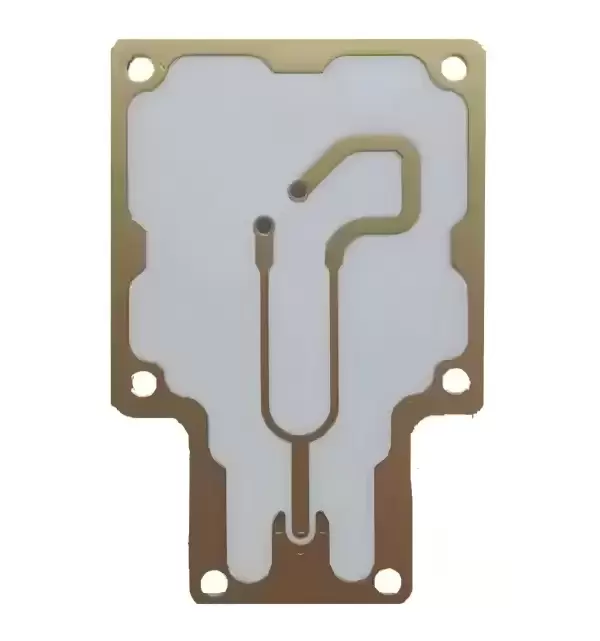
Lumen Depreciation: Where Thermal Design Becomes Visible
Lumen depreciation is where thermal performance becomes obvious to end users.
Even if a system meets its initial brightness target, poor thermal control will shorten the time it can maintain that level. High junction temperature accelerates both chip degradation and phosphor aging.
In systems built on a ceramic PCB for LED lighting, improved heat transfer reduces the rate of this degradation. In practical terms, many designs show a 20%–30% reduction in lumen depreciation over time.
This does not mean the system is brighter at the beginning. It means it stays consistent longer.
For applications such as street lighting or commercial installations, this difference is significant. Lighting systems are expected to operate for years without noticeable change. A slower degradation curve directly translates into fewer replacements and more predictable performance.
High-Density LED Layouts: Controlling Thermal Interaction Between Chips
As LED modules become more compact, designers are forced to place more chips into smaller areas. This increases power density and creates new thermal challenges.
In tightly packed layouts, heat from one LED can affect neighboring devices. This interaction is often overlooked during early design stages, but becomes visible after extended operation.
Without effective heat spreading, certain areas of the board become hotter than others. This leads to uneven brightness and increases the risk of localized failure.
A ceramic PCB for LED lighting addresses this by allowing heat to spread more efficiently across the substrate. Instead of remaining concentrated near the source, heat moves laterally and distributes across a larger area.
In high-density modules, this can reduce temperature variation by 30%–50%, keeping all LEDs within a similar operating range.
From a system perspective, this improves light uniformity and reduces long-term reliability issues.
Continuous Operation: Why Stability Matters More Than Peak Performance
Many LED systems are designed for continuous operation. Outdoor lighting, industrial fixtures, and automotive systems often run for thousands of hours without interruption.
In these conditions, peak performance is less important than stability.
A system that runs slightly cooler but degrades unevenly will still fail to meet long-term requirements. What matters is whether the thermal path remains consistent over time.
A ceramic PCB for LED lighting maintains its thermal behavior even after extended exposure to heat. Its structure does not change significantly with temperature, which helps preserve a stable heat transfer path.
This consistency prevents gradual performance drift and allows the system to operate within predictable limits.
Application-Level Impact: Where the Difference Becomes Obvious
Automotive Lighting
In automotive systems, space is limited and ambient temperature can be high. Headlamp modules must operate reliably under continuous load while maintaining consistent light output.
Using a ceramic PCB for LED lighting helps control junction temperature and reduces thermal variation across the module. This improves both performance stability and reliability over the vehicle’s lifetime.
Outdoor and Street Lighting
Outdoor lighting systems operate in sealed or semi-sealed environments where airflow is limited. Heat must be managed within the structure itself.
In these conditions, thermal inefficiency leads to faster degradation and more frequent maintenance.
A ceramic PCB for LED lighting reduces heat buildup and slows performance decline, allowing systems to maintain stable output over extended periods.
Industrial Lighting
Industrial applications often involve high power levels and long operating hours. Fixtures are expected to perform consistently with minimal maintenance.
Here, the benefit of a stable thermal path becomes clear. Systems built on ceramic substrates show fewer performance variations and longer service intervals.
Lifespan Extension: A Direct Result of Thermal Control
One of the most measurable outcomes of improved thermal management is extended service life.
In many high-power LED systems, noticeable degradation appears after around 20,000 hours when thermal conditions are not well controlled.
With a ceramic PCB for LED lighting, improved heat transfer and reduced stress can extend operational life to 50,000 hours or more.
This improvement comes from two factors:
•lower average junction temperature
•reduced thermal cycling stress
Together, these factors slow down both material degradation and mechanical fatigue.
System Design Implications: Less Compensation, More Efficiency
When thermal performance improves at the PCB level, the entire system design changes.
Instead of compensating for poor heat transfer with larger heat sinks or additional cooling, engineers can design more efficient structures from the start.
This often leads to:
•smaller and lighter cooling components
•reduced material usage
•simpler assembly processes
Energy efficiency also improves, as less power is lost as heat.
A ceramic PCB for LED lighting allows the system to manage heat internally, rather than relying heavily on external solutions.
Manufacturing Reality: Where Good Designs Can Still Fail
Material selection alone does not guarantee performance. Manufacturing quality plays a critical role in whether the expected thermal behavior is achieved.
The interface between copper and ceramic is particularly sensitive. Any inconsistency in bonding can introduce localized thermal resistance.
These issues are not always visible during initial testing. They tend to appear after repeated thermal cycles, when small defects begin to grow.
An experienced pcb fabrication manufacturer focuses on controlling these details. Uniform bonding, stable layer structure, and controlled stress distribution are all necessary to maintain long-term reliability.
Without this level of control, even a well-designed ceramic PCB for LED lighting can show performance variation over time.
Quantified Performance Summary
| Parameter | Typical Value / Improvement | Observed Result |
|---|
| Thermal Conductivity (AlN) | 170–200 W/m·K | Faster heat transfer from junction |
| Junction Temperature Reduction | 10–20°C | Lower thermal stress, improved stability |
| Lumen Depreciation | 20%–30% slower | More consistent brightness over time |
| Service Life | 20,000 → 50,000+ hours | Extended operational lifespan |
| Heat Spreading Efficiency | 30%–50% improvement | Reduced hotspots in dense layouts |
| Temperature Uniformity | Significantly improved | Stable performance across all LEDs |
FAQ: Practical Questions From Real Projects
Why does thermal performance vary so much between LED modules?
Most variation comes from differences in the junction-to-board heat path. If heat cannot move away quickly, temperature rises and performance becomes unstable.
Is a 10–20°C reduction really significant?
In LED systems, yes. Even a small reduction in junction temperature can noticeably slow down degradation and extend lifespan.
Does ceramic PCB completely eliminate thermal issues?
No. It improves heat transfer significantly, but overall performance still depends on system design, including heat sinks and layout.
When is AlN preferred over Al₂O₃?
AlN is typically used in higher power applications where maximum heat transfer is required. Al₂O₃ is suitable for moderate power levels with stable performance requirements.
Stability Comes From Controlling the Heat Path
In high-power LED lighting, long-term performance is determined by how heat is handled inside the system.
A ceramic PCB for LED lighting provides a stable and efficient thermal path, reducing temperature variation and slowing down degradation.
The result is not just better thermal performance, but more consistent operation over time.
For systems expected to run continuously and maintain stable output, this difference is not optional. It is part of the foundation that determines whether the design holds up in real conditions.
About the auther:

Sonic Yang
As a major of Electronics and Mechanical Automation, Sonic has been engaged in PCB design, R&D, manufacturing of eletronics for around 22 years, as engineering director and coordinates with supply chain(components&CNC parts), providing professional supports and consults for global customers.

 en
en


 WhatsApp