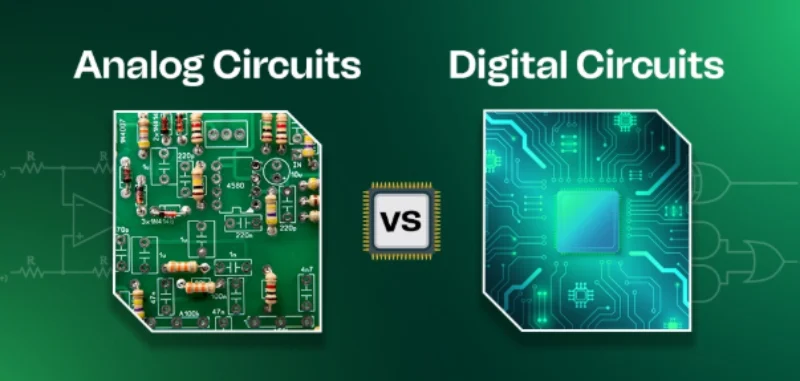
Digital and analog circuits are two pillars of electronic technology, fundamentally different in their working principles, design methods, and application areas. They play distinct roles and have varying relationships within the signal processing flow. In this artile, we are going to list and compare their differences, characteristics, and applications in details.
Core Difference: Signal Properties
| Characteristics | Analog Circuits | Digital Circuits |
| Signals | Continuous signals (amplitude and time are continuous)
Examples: sine waves, temperature changes | Discrete signals (amplitude and time are discrete)
Represented by 0 and 1 (high and low levels) |
| Representation Content | Directly represents the actual value of a physical quantity (voltage, current) | Represents binary encoded data, logic states |
| Design Goals | Accurately amplify, filter, and transform continuous signals | Achieve accurate logical operations, data processing, and storage |
| Interference Resistance | Weak. Noise is directly superimposed on the signal, making separation difficult. | Strong. As long as interference does not violate the threshold for distinguishing between "0" and "1", information can be transmitted without loss. |
| Design Complexity | Extremely high requirements for component matching, layout and routing, and noise suppression; high design difficulty. | Highly automated (EDA tools), modular and integrated design is possible, relatively easy. |
| Accuracy | Limited by component precision, temperature drift, and noise. | Determined by the number of binary bits, extremely high precision (e.g., 32-bit, 64-bit) can be achieved. |
| Core Components | Operational amplifiers, transistors (linear region), resistors, capacitors, inductors; | logic gates (AND, OR, NOT, etc.), flip-flops, microprocessors, memory. |
| Main Functions | Amplification, filtering, modulation/demodulation, signal conversion, power management; | logic operations, arithmetic operations, data storage, program control. |
In-depth Analysis and Application Scenarios
1. Analog Circuits: The Interface to the Real World
Analog circuits handle continuously changing physical quantities; they are the bridge connecting the digital and physical worlds.
● Characteristics: Signals are "smooth" curves; every point is meaningful.
● Advantages: Can directly process real-world signals; simple circuits (for simple functions); good real-time performance.
● Disadvantages: Susceptible to interference; difficult to implement complex calculations and storage; difficult design and debugging.
Typical Applications:
● Signal Conditioning: Amplification and filtering of weak signals from sensors (such as ECG signals, microphone signals).
● Radio Frequency Communication: RF front-end for mobile phones and Wi-Fi, performing signal modulation, demodulation, and mixing.
● Power Management: Linear Regulators (LDOs), switching power supplies (DC-DC).
● Audio/Video Processing: Analog power amplifiers, video drivers.
2. Digital Circuits:
The Brain of Calculation and Decision-Making Digital circuits process discrete binary signals and are the core of modern computers, communications, and smart devices.
● Characteristics: Signals are "stepped," with only two states: high (1) and low (0).
● Advantages: Strong anti-interference capability, high precision, easy to store, process, and program, and extremely high integration density (e.g., CPUs integrating billions of transistors).
● Disadvantages: Cannot directly interact with the analog world; requires a converter interface.
Typical Applications:
● Microprocessor/CPU: The brain of computers and mobile phones.
● Memory: RAM, ROM, Flash. - Logic Control: FPGA, CPLD, used for industrial control and communication protocol processing.
● Digital Signal Processing: Image encoding/decoding, audio encoding/decoding, encryption/decryption.
Why are both indispensable in modern electronic devices?
Observing the initial comparison diagram, a complete electronic system (such as a smartphone) is a perfect combination of analog and digital:
1. Perceiving the World: Analog circuits are responsible for receiving continuous analog signals from microphones (sound), cameras (light), and touchscreens (pressure).
2. Conversion: Analog signals are converted into digital signals via analog-to-digital converters (ADCs).
3. Processing Core: Digital circuits (CPU, DSP) perform complex processing on these digital signals, including compression, enhancement, and recognition.
4. Output: The processed digital signals are converted back into analog signals via digital-to-analog converters (DACs).
5. Influencing the World: Analog circuits (such as audio amplifiers and screen drivers) amplify the analog signals, driving speakers to emit sound or displaying images on the screen.
Simple Analog Comparison:
● Analog circuits are like human senses and muscles (directly sensing and acting upon the world).
● Digital circuits are like the human brain (thinking, remembering, making decisions).
● ADCs/DACs are like translators, transmitting information between the senses and the brain.
Learning and Development
● Analog circuits: Rely more on physical intuition and experience, often called "an art." Easy to learn, extremely difficult to master. Requires a solid foundation in semiconductor physics and circuit theory.
● Digital circuits: Emphasize logical thinking and system architecture. After mastering the basics, complex systems can be quickly designed using hardware description languages (such as Verilog/VHDL).
In summary: Analog circuits handle "waveforms," while digital circuits handle "symbols." They complement each other, together constructing the rich and diverse electronic world we know today. If you want to delve deeper into the field of electronics, both are indispensable foundations.

 en
en

 WhatsApp